
Friday, December 22, 2006
Digging Out
After a week of heavy snows and much too much snow (and high-centering my car and apparently doing serious damage to my catalytic converter), I've not been paying much attention to anything (except the presents I still need to buy). So, please excuse the light posting. I'll catch up with the world eventually.

Friday, December 15, 2006
My year in books
Twenty five books in year without classes and while finishing my MFA thesis doesn't sound too bad. I'm calling it at twenty five because you can see my current read is Richard Ford's The Lay of the Land and I don't anticipate finishing it in the next two weeks. There have been good books and there have been bad. Now, keep in mind that when we talk about merit in such terms we are looking at it through one reader's perspective.
Let's start with the bad books I read this year. Now I knew Bad Twin, written by a fictional character Gary Troupe, was going to be a bad book, but Curtis Sittenfeld's Prep came with a lot of praise and I was surprised to be so annoyed by it. The other surprisingly bad book was Jay McInerney's Bright Lights, Big City.
Then there were the classics I was glad to get to, but didn't move me too much like Portnoy's Complaint, The Sound and the Fury, Herzog, A Farewell to Arms, and To the Lighthouse. And more recent books that didn't do too much for me, Slow Man, Never Let Me Go, The Feast of Love, The Bushwhacked Piano, and Everyman.
Now on to the good. The three bad books above were all read directly after Charles D'Ambrosio's short story collection The Dead Fish Museum. That book is so good that it could make many actually good books look bad. This was also the year I discovered Cormac McCarthy. Suttree knocked me out of my boots. I haven’t been as compelled to read as I was while reading those nearly 400 pages. I did get to The Road this year and I do think it deserves all the praise it's been getting, but it was so darn depressing. And it just wasn't as good as Suttree. Then Joyce Carol Oates's We Were The Mulvaneys also made a difference for me, as did Daniel Woodrell's Winter's Bone, Marilynne Robinson's Housekeeping and, of course, To Kill a Mockingbird. While I learned this year that I may have set my standards too high, it's good to know that there are books out there, both old and new, that can reach them.
Of course one book I read has to be the best book I read this year, but I'll save that for another post.
Let's start with the bad books I read this year. Now I knew Bad Twin, written by a fictional character Gary Troupe, was going to be a bad book, but Curtis Sittenfeld's Prep came with a lot of praise and I was surprised to be so annoyed by it. The other surprisingly bad book was Jay McInerney's Bright Lights, Big City.
Then there were the classics I was glad to get to, but didn't move me too much like Portnoy's Complaint, The Sound and the Fury, Herzog, A Farewell to Arms, and To the Lighthouse. And more recent books that didn't do too much for me, Slow Man, Never Let Me Go, The Feast of Love, The Bushwhacked Piano, and Everyman.
Now on to the good. The three bad books above were all read directly after Charles D'Ambrosio's short story collection The Dead Fish Museum. That book is so good that it could make many actually good books look bad. This was also the year I discovered Cormac McCarthy. Suttree knocked me out of my boots. I haven’t been as compelled to read as I was while reading those nearly 400 pages. I did get to The Road this year and I do think it deserves all the praise it's been getting, but it was so darn depressing. And it just wasn't as good as Suttree. Then Joyce Carol Oates's We Were The Mulvaneys also made a difference for me, as did Daniel Woodrell's Winter's Bone, Marilynne Robinson's Housekeeping and, of course, To Kill a Mockingbird. While I learned this year that I may have set my standards too high, it's good to know that there are books out there, both old and new, that can reach them.
Of course one book I read has to be the best book I read this year, but I'll save that for another post.
Wednesday, December 13, 2006
Book Review: To the Lighthouse

To the Lighthouse by Virginia Woolf
It is easy to forget that Woolf is a modernist. I read and enjoyed Mrs. Dalloway, though it wasn't an easy read, and I understand the stream of consciousness, the way the thoughts and narration flit around. To the Lighthouse took this to an extreme. The first section was not unlike Mrs. Dalloway, with seemless shifts in perspective, dialogue that we get through the perspective, not direct quotes. It is not always easy to follow the concrete action, but it makes some sense. The second section of the novel drops all that came before and falls into an abstract and nearly poetic mode. We do not see things through any character's mind, except maybe that of the house itself. The language in this section is beautiful and, though we learn some things about the intervening years, nothing happens. Then the third section comes and we're given a meding of the two previous modes. We get different character's points of view, but the abstractions are so great that it's hard to really graso what they're thinking. I like the stream of consciousness and the beauty of it, but not enough of it registered with me to really take anything from it.
It is easy to forget that Woolf is a modernist. I read and enjoyed Mrs. Dalloway, though it wasn't an easy read, and I understand the stream of consciousness, the way the thoughts and narration flit around. To the Lighthouse took this to an extreme. The first section was not unlike Mrs. Dalloway, with seemless shifts in perspective, dialogue that we get through the perspective, not direct quotes. It is not always easy to follow the concrete action, but it makes some sense. The second section of the novel drops all that came before and falls into an abstract and nearly poetic mode. We do not see things through any character's mind, except maybe that of the house itself. The language in this section is beautiful and, though we learn some things about the intervening years, nothing happens. Then the third section comes and we're given a meding of the two previous modes. We get different character's points of view, but the abstractions are so great that it's hard to really graso what they're thinking. I like the stream of consciousness and the beauty of it, but not enough of it registered with me to really take anything from it.
Tuesday, December 12, 2006
Le Poète est semblable au prince des nuées

It's not everyday that I get to point to something about Baudelaire, but now the occasion is here.
Powell's Review-a-Day features a review from Rain Taxi for a new translation of Baudelaire's Les Fleurs du Mal by Keith Waldrop. And it's not your everyday translation: The form of Waldrop's translation is versets, "a form that hovers between poetry and prose," as the book's front flap advertises.
I have long been a fan of Baudelaire and for just as long I've wanted to write my own translations of his poetry (I've translated only around a dozen). Every translation I've read seems insufficient, relying on replicating the rhyme or rhythm The words, though, are the important part. It is what Baudelaire's saying that moves me.
I don't know if this translation will give me what I want in English. I'm afraid that Waldrop is after something stylistically that compromises Baudelaire's intent. I'm willing to give it a try, though.
The relevance of the NYTBR
Dan Green at the Reading Experience evaluates NYTBR editor Sam Tannenhaus's statement that "novelists and short-story writers have begun to rediscover the uses of narrative and to find new ways of making their imagined creations more relevant to our complicated moment."
I should admit that I am a bit of a traditionalist myself, but I had a similar reaction to Tannenhaus's statement. But after looking at the selections and his track record, I think he was just looking for a way of explaining why they liked more fiction this year--without really knowing what he was saying.
We must remember that any review (or best-of list) is entirely subjective. To talk about "relevance" only means that he likes "relevant" books. It shouldn't slow anyone down from writing totally irrelevant books. We might all want a good review in the NYTBR, but that's not why we're writing.
Frankly, I find this critical tic of Tanenhaus's--American fiction has abandoned narrative--rather baffling. I defy him to look at the literary fiction shelves (even allowing him to walk past the genre aisles) at Borders and Barnes and Noble and point out what books do not in fact dispense narrative in fairly heavy doses.
[...]
Let's invite the same fools and charlatans who dominate the news and opinion sections over to the Book Review and make it into the same kind of intellectual sinkhole.
I should admit that I am a bit of a traditionalist myself, but I had a similar reaction to Tannenhaus's statement. But after looking at the selections and his track record, I think he was just looking for a way of explaining why they liked more fiction this year--without really knowing what he was saying.
We must remember that any review (or best-of list) is entirely subjective. To talk about "relevance" only means that he likes "relevant" books. It shouldn't slow anyone down from writing totally irrelevant books. We might all want a good review in the NYTBR, but that's not why we're writing.
Rejection Collection - Greensboro Review

This one came yesterday from Greensboro Review for my story "The Disguise," originally sent to them in July. For such a large slip of paper, the actual rejection note is quite short and bland. This one needs some rethinking.
In addition, yesterday I received a letter from Shenandoah acknowledging receipt of my submission and pimping a subscription, including a card reprint of the journal cover. Seems like a long way to go to try and sell me a subscription. And the special writers' rate is $20--I think they could do a little better. I shouldn't complain, though, while they're reviewing my submission.
Saturday, December 09, 2006
Tony Scott takes on Alice Munro
NY Times film critic A.O. Scott looks at two new books by Alice Munro, a collection of older stories titled Carried Away and a new collection of semi-autobiographical stories called The View From Castle Rock. That last one's on my wish list (hint, hint).
Thursday, December 07, 2006
At least someone will read it
 It may have been written to help Bush find a way out of Iraq, but now it looks like the Iraq Study Group Report is set to become a best seller(Sales soar for Iraq study group's book). I should admit that the 9/11 Commission Report is on my shelf and I'm likely to buy this thing as well. I don't know if I'm just into the whole bipartisan thing, or if it's the historical significance of it.
Now I could wander off on a rant about The Way Forward or A New Approach, but it might not be advised tonight. At least it will give everyone the cover they need. Let's move forward now.
Best books of the year?
At this time of the year and these sorts of lists appear everywhere, it is worthwhile to consider what we've read this year. What was the best book you read this year? Or what was the best book you read that was actually published this year?
Things to consider. I'll let you know my picks soon.
Things to consider. I'll let you know my picks soon.
Tuesday, December 05, 2006
And still more...
The Denver Post this time: Recommend: Fiction
And though this one also includes The Road, I wouldn't give this list much credit... it also includes Thirteen Moons.
And though this one also includes The Road, I wouldn't give this list much credit... it also includes Thirteen Moons.
NYTBR Best Books
I feel obligated to pass this along: NYTBR The 10 Best Books of 2006.
And... I haven't read a one. Yet.
And... I haven't read a one. Yet.
Saturday, December 02, 2006
My Other Life
Sometimes the real world catches up with you. It's the day job. I'm working like mad and too busy at work to even try to catch up with the literary world. Unfortunately i tlooks like I'm missing a good debate on bloggers' book reviews, on which I will have to comment at some point.
It is unfortunate that my time limits me from giving a more thoughtful analysis of things (if that's even possible through this medium), especially after I've started sending out the weekly newsletter.
I hope you'll stick with me during this busy season. I usually get a little loopy when I'm tired, so things could get interesting.
It is unfortunate that my time limits me from giving a more thoughtful analysis of things (if that's even possible through this medium), especially after I've started sending out the weekly newsletter.
I hope you'll stick with me during this busy season. I usually get a little loopy when I'm tired, so things could get interesting.
Tuesday, November 28, 2006
Killer Bookcase
The fun/sadness is in the story itself: Bookcase 'trap' killed US woman
The body of a missing US woman has been found by her family, wedged upside down behind a bookcase in her room.
Mariesa Weber, 38, is believed to have fallen over and become trapped as she tried to reach behind the bookcase to adjust the plug for a TV set.
[...]
Her body was eventually discovered when her sister noticed a foot protruding behind the bookcase in her bedroom.
"I'm sleeping in the same house as her for 11 days, looking for her. And she's right in the bedroom," the woman's mother, Connie Weber, told the St Petersburg Times newspaper.
The family told the newspaper they had noticed a strange smell from her room but had blamed it on rats.
(via Bookninja)
The body of a missing US woman has been found by her family, wedged upside down behind a bookcase in her room.
Mariesa Weber, 38, is believed to have fallen over and become trapped as she tried to reach behind the bookcase to adjust the plug for a TV set.
[...]
Her body was eventually discovered when her sister noticed a foot protruding behind the bookcase in her bedroom.
"I'm sleeping in the same house as her for 11 days, looking for her. And she's right in the bedroom," the woman's mother, Connie Weber, told the St Petersburg Times newspaper.
The family told the newspaper they had noticed a strange smell from her room but had blamed it on rats.
(via Bookninja)
NYT Notable Books of 2006
So, the NYT has picked it's notable books of the year and of course there are some good ones on the list:
ABSURDISTAN. By Gary Shteyngart.
AGAINST THE DAY. By Thomas Pynchon.
THE COLLECTED STORIES OF AMY HEMPEL.
THE DEAD FISH MUSEUM. By Charles D'Ambrosio.
THE ECHO MAKER. By Richard Powers.
EVERYMAN. By Philip Roth.
GALLATIN CANYON: Stories. By Thomas McGuane.
HIGH LONESOME: New & Selected Stories, 1966-2006. By Joyce Carol Oates.
THE INHERITANCE OF LOSS. By Kiran Desai.
THE LAY OF THE LAND. By Richard Ford.
ONLY REVOLUTIONS. By Mark Z. Danielewski.
THE ROAD. By Cormac McCarthy.
TERRORIST. By John Updike.
TWILIGHT OF THE SUPERHEROES. By Deborah Eisenberg.
READING LIKE A WRITER: A Guide for People Who Love Books and for Those Who Want to Write Them. By Francine Prose.
Of the list, fiction and non-fiction, I've only read four. That's probably more than I did last year.
ABSURDISTAN. By Gary Shteyngart.
AGAINST THE DAY. By Thomas Pynchon.
THE COLLECTED STORIES OF AMY HEMPEL.
THE DEAD FISH MUSEUM. By Charles D'Ambrosio.
THE ECHO MAKER. By Richard Powers.
EVERYMAN. By Philip Roth.
GALLATIN CANYON: Stories. By Thomas McGuane.
HIGH LONESOME: New & Selected Stories, 1966-2006. By Joyce Carol Oates.
THE INHERITANCE OF LOSS. By Kiran Desai.
THE LAY OF THE LAND. By Richard Ford.
ONLY REVOLUTIONS. By Mark Z. Danielewski.
THE ROAD. By Cormac McCarthy.
TERRORIST. By John Updike.
TWILIGHT OF THE SUPERHEROES. By Deborah Eisenberg.
READING LIKE A WRITER: A Guide for People Who Love Books and for Those Who Want to Write Them. By Francine Prose.
Of the list, fiction and non-fiction, I've only read four. That's probably more than I did last year.
Monday, November 27, 2006
Rejection Collection - AGNI
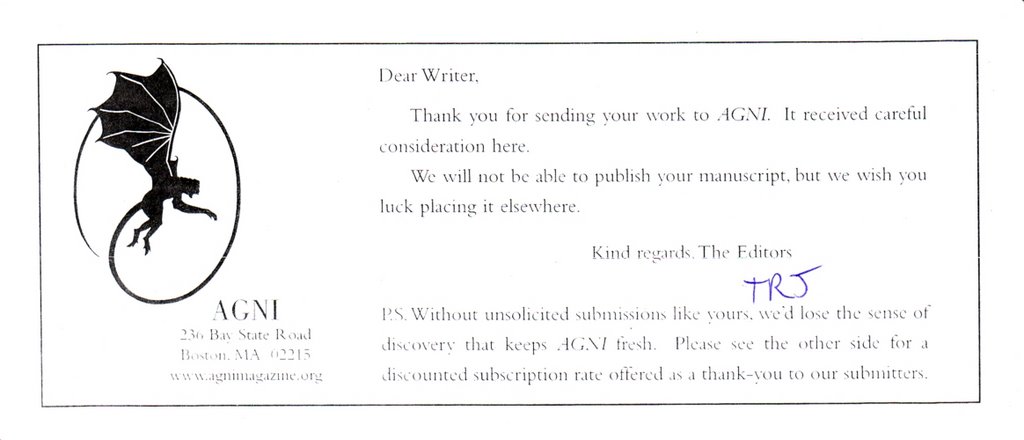
Now, this has to be the quickest turn around I've ever seen out of a lit journal. I sent out my story "Resting" to them on the 14th of this month and on the 24th I received this kind rejection from AGNI. Now, what I appreciate about this one, besides the turnaround, is the enticement to purchase a subscription and discount rate for submitters. Good idea. What doesn't work is that they put the form on the back of the rejection. Don't they realize that I'm putting this in the fat file with all the others?
Friday, November 24, 2006
Vacation Filler: The Black Angels
I just love coming across new music. Today, it's Austin's The Black Keys. Enjoy.
Thursday, November 23, 2006


Tuesday, November 21, 2006
When in doubt, just write.
It is funny that we occasionally need to be reminded of some of the basic tenets of writing.
I found myself over the weekend at a point in “the project” where I knew what was to take place in the present action, but I needed to inform the reader about things from the character’s past that has put him in the current position and made him who he is in the present action. The trouble was that I couldn’t think of one specific event I could use, something that he might remember that would really explain things. I thought I was blocked.
I had the first sentence of the scene written but was afraid to put anything else down until I knew where I was going, So, I put myself through a free-writing exercise, putting down on paper some of the things I had been keeping in my head about him. What I wound up with was only more generalities, no specifics. I had the concepts for what changed him, but still nothing concrete I could use.
I decided to go on with the present action. If I needed to come in and put in another scene later, I would. What I found, though, (and here’s where we get back to basics) was that the thing wrote itself. I didn’t need to say “okay, I need to throw in this specific scene where his father ignores him,” or some such thing. Instead, many little mini-scenes appeared, little bits of action or images along with the character’s opinions of the past. This told more about what he’d been through and where he was than any contrived scene would have.
And so I’m reminded of a couple things that even the silliest of writing books tell us. First, contrivance is what it is and will appear as much on the page, and it is right to be reluctant to do it. And of course, just write. Keep at it. Have faith that you’ll sort out what needs it, either through the course of writing or during the writing. A familiar pearl of wisdom, I understand, but sometimes we need to be reminded.
I found myself over the weekend at a point in “the project” where I knew what was to take place in the present action, but I needed to inform the reader about things from the character’s past that has put him in the current position and made him who he is in the present action. The trouble was that I couldn’t think of one specific event I could use, something that he might remember that would really explain things. I thought I was blocked.
I had the first sentence of the scene written but was afraid to put anything else down until I knew where I was going, So, I put myself through a free-writing exercise, putting down on paper some of the things I had been keeping in my head about him. What I wound up with was only more generalities, no specifics. I had the concepts for what changed him, but still nothing concrete I could use.
I decided to go on with the present action. If I needed to come in and put in another scene later, I would. What I found, though, (and here’s where we get back to basics) was that the thing wrote itself. I didn’t need to say “okay, I need to throw in this specific scene where his father ignores him,” or some such thing. Instead, many little mini-scenes appeared, little bits of action or images along with the character’s opinions of the past. This told more about what he’d been through and where he was than any contrived scene would have.
And so I’m reminded of a couple things that even the silliest of writing books tell us. First, contrivance is what it is and will appear as much on the page, and it is right to be reluctant to do it. And of course, just write. Keep at it. Have faith that you’ll sort out what needs it, either through the course of writing or during the writing. A familiar pearl of wisdom, I understand, but sometimes we need to be reminded.
Subscribe to:
Posts (Atom)