Showing posts with label New Yorker. Show all posts

Tuesday, January 03, 2012

The Usual Year-End Thing


I suppose the year’s end requires some sort of reflection. There can be value in looking back, but it seems like we look back for things to regret, mistakes made, things we’d like to do better in the coming year. This doesn't seem to me like a fruitful exercise.

I know that there is a long list of failures, objectives unfulfilled. But if I’ve learned anything in the last year, it is not to set my sights too high. Trying to achieve too much is bound to lead to failure. Overachiever or not, my expectations for myself need to be reasonable.

In thinking about the new year, and resolutions for it, I know that I need to de-task. I need to get some things off my to-do list. And not by getting them done. By never putting them there in the first place. Starting with the stacks of unread magazines. I will not be renewing any magazine subscriptions in 2012. Sorry New Yorker. Sorry BusinessWeek and Harvard Business Review. My backlog is enough to carry me a year or more without a new edition appearing in my mailbox.

Another objective must be to focus. At any given time I have many projects in the works. I make plans to do this little bit on this project, another little bit of another, filling my spare hours with this variety of tasks with completion expected by the end of the week. This might just be unreasonable. It just leaves me with a long list of partially finished or unfinished and neglected objectives. Pick the next important thing on the list of things to do (let’s keep calling them objectives) and see it through until it’s done. I am more productive when I’m allowed to obsess over one thing instead of multitasking.

This, though, applies to everything but writing. I have found that I work better in short bursts. If I sit down, writing a first draft, for much longer than an hour, I find I begin rushing to the next sign post, the next major event. When I work for short periods, I am allowed to keep my creativity focused on what is before me. In an extended period, I start trying to look further down the road, and rush to get there.

Without the looking back and beating myself up, I’ve managed to make some resolutions. Now to stick to them--and not beat myself up if I don’t.

Sunday, November 13, 2011

The Meaning of My Library

I have never counted the books in my personal library. Indeed, the total figure grew within the last few weeks after the library's book sale. I'm nervous, though, that the number of unread outnumber the read.

Maybe this isn't all bad. If I had read them all, where would be the fun of browsing my library for the next book to read? An argument could be made for disposing of all books already read. Save those one might want to return to for reference.

A personal library, though, is so much more than a grouping of books either read or unread. The books are there to tell the observer something about the library's owner. Even if that observer is the owner. I don't get many observers down to my basement office where most of my library is confined, but I still enjoy looking over my books. The various titles, the colored spines, remind me not only of the stories within, but also of the person I was at the time. Various bits of my collection remind me of who I was an who I think I am.

Not my library. You can tell by the Ken Follett and the Janet Evanovich.
To see on my shelf Updike's The Afterlife, I remember the day of waiting for jury duty. To see Celine's Journey to the End of the Night, I'm reminded of two distinct points in my life when I read the novel. The first time makes me recall an early morning after a late night, drinking coffee downtown watching the business world start up its day.  The second time, I was well ensconced in that business world. Or McCarthy's No Country for Old Men, devoured while laying on the couch of my current home.

When visiting someone's house, I am drawn to the books on their shelves. Yes, I am judging them by what they've chosen to put on display. The books there are meant to be a representation of the owner. And if there is a disregard for which books are on the shelves for public display, that tells me something (disappointing) too.

In an article, "Shelf Life", in last week's New Yorker, James Wood explores the meaning and meaninglessness of our libraries. He sums up the sentiment thus:

Libraries are always paradoxical: they are as personal as the collector, and at the same time are an ideal statement of knowledge that is impersonal, because it is universal, abstract, and so much larger than an individual life.

The books on my shelf mean something to me not only because they represent me to myself, but because they represent me to the observer as well. And as personal as the identity that is created can be, it is in the universal that it finds meaning. But, as Wood asks,"Isn't a private library simply a universal legacy pretending to be an individual one?"

A library is a showcase and I've known more than one person who has used bookshelves to demonstrate superiority. Some would likely say I'm guilty of the same. The trashy novels are relegated to a bookshelf in the guest room.

Where, though, does this universality go when all of these titles are contained in a small piece of electronic hardware? Do I care about the representation they form? I would say they mean significantly less.

When books are commoditized, stripped of their physical presence, their abstract value is reduced. They have no presence. They are experiential only. We have the pleasure of reading and the meaning found in the words, but those e-ink letters don't represent me in the same way a book, those same words on paper and bound between covers, does. The electronic list of titles, browsed with a push of a button, does not please me, does not force recall of memories and desire, as much as does a simple glance at my shelves.

The materialism of it is something that probably gives many book owners/collectors worry. There are many books on my shelves that I will never open again. But still they are there to tell me something. They are there, though, to give me pleasure, to help me recall the stories within and the stories of my own life when I read the book. And it real is this pleasure that matters. It is this pleasure that gives my library meaning.

Tuesday, June 22, 2010

Lower E-Reader Prices Make Them More Tempting

I've said this before: I'm a book guy. Good old fashioned paper books, complete with the smell, the weight, the feel. Yet, as the prices for e-readers like the Nook and the Kindle come down to earth, I find them tempting. It's not that I want to toss away my library and clear my bookshelves for knick-knacks, but I like the idea of a library in a slim piece of electronic gadgetry.

I don't think of books as consumables. I don't read books and then dismiss them. I like knowing they still exist on my shelf (in a tangible, physical form) for me to reference. I know that if I want to go back to a particular story in Denis Johnson's Jesus' Son, the book is there. E-readers are good for folks who might read a book once and be done with it, but I'm beginning to think that they might be good for reference too. Might not be bad, when I'm sitting down to write several pages tonight, to pull out a Kindle and reread "Car Crash While Hitchhiking." And I think they might be very good for non-fiction, for the important books that come out in hardback and make a stir but you don't necessarily need them on your bookshelf for all of eternity (I still need to get around to Nassim Taleb's Black Swan).

And what about magazines? I am definitely a magazine reader, thought I rarely seem to get through them. Wouldn't an e-reader be the best place for The New Yorker or Business Week?

So, I'm tempted.

I did put my hands on a Nook a couple of weeks ago, and I wasn't impressed. It felt clunky and the model on display at the store was stuck loading a page. The sales person had to power it off and back on to get it working again.

But then I wonder if I would be doing damage to two industries I'm fond of, publishing and bookselling. I'd rather not aid in the demise of either.

I'm not convinced that I'm buying one of these things yet, but with more reasonable pricing it is worth considering.

Sunday, November 29, 2009

Short Story Review: DeLillo in the New Yorker

"Midnight in Dostoevsky" by Don DeLillo, in the November 30, 2009, New Yorker

Maybe it's me. I've been pretty task-driven lately. That means no real pleasure reading. This makes reading short stories a little difficult. The brevity is helpful, but without a purpose, without resolution, I'm hard-pressed to come away with anything from them.

This is the case with Don DeLillo's short story "Midnight in Dostoevsky" that appeared in the New Yorker. A sentence from the final paragraph sums it up: "I wondered what it was that had caused this thing to happen."

I really enjoyed DeLillo's White Noise, and I think that makes me more inclined to like his work. This was certainly one of the reasons I took the time to read this story. As good as the writing was, I came away disappointed.

The story follows a pair of eccentric college students in cold Midwestern town. They think they know everything, even when they know that they don't. The imagine the the life of a distracted logic professor and they make up the life of an old man they pass on the street. The central character talks to a female student who, it turns out, talks just like him and then disappears from the story. And in the end there is a bit of pointless violence that comes out of nowhere, serves no purpose and leaves us hanging.

Surely DeLillo could place any story he wants in the New Yorker. And I doubt if the editors are going to criticize much. Of course there is good writing here:

I knew where my father was--in Beijing, trying to wedge his securities firm into the Chinese century.

At the library, I devoured about a hundred pages a setting, small cramped type.

He shaves, we thought. He cuts himself and says shit. He wads up a sheet of toilet paper and holds it to his cut. Then he leans into the mirror, seeing himself clearly for the first time in years. Ilgauskas, he thinks.

I just was hoping for a little more from DeLillo in the New Yorker. But, then again, maybe it's me.

Tuesday, November 25, 2008

New Yorker Fiction: “Ghosts” by Edwidge Dandicat

Edwidge Danticat’s story “Ghosts” in the Nov. 24 edition of the New Yorker focuses on a young man living in Haiti among slums and gangsters. Danticat’s style is more reportage than description. Told in third person, the story avoids delving too deep in the mind of the protagonist, Pascal, or giving us any real description of setting. We are given facts, some thoughts, and little else.

The story does, though, go deep. Pascal, a young man trying to find his way and avoid the lifestyle that surrounds him, falls into the fantasies that trap many of us. Dreaming of hosting his own radio show, he imagines,

It would be controversial at first, but soon people would tune in by the thousands. A kind of sick voyeurism would keep them listening, daily, weekly, monthly, however often he was on. People would rearrange their schedules around it. They wouldn’t be able to stop discussing it.

The fact-based style doesn’t illuminate or excite. The reader may be interested in finding out what happens, but he isn’t captivated. Only near the end does Danticat open the story up some, stepping away from the action, to go deeper, with Pascal again fantasizing about, this time, a new radio program:
He would open with a discussion of how many people in Bel Air had lost limbs. Then he would go from limbs to souls, to the number of people who had lost family—siblings, parents, children—and friends. These were the real ghosts, he would say, the phantom limbs, phantom minds, phantom loves that haunt us, because they were used, then abandoned, because they were desolate, because they were violent, because they were merciless, because they were out of choices, because they did not want to be driven away, because they were poor.

“Ghosts” tells of a life, a world about which I know nothing, which I can hardly understand. It does come close to helping me comprehend the problem.

Friday, December 21, 2007

"... and take out all the good things I said about you."


Sometimes that New Yorker subscription actually proves worthwhile. This week it's the Raymond Carver special, with a Gordon Lish-free version of Carver's story "Beginners." And then they threw in a version with all the Lish edits (online only), an article on the relationship between writer and editor, and some correspondence between Lish and Carver, closing with this letter from Carver to Lish:
What’s the matter, don’t you love me anymore? I never hear from you. Have you forgotten me already? Well, I’m going back to the [Paris Review] interview and take out all the good things I said about you.
Maybe I'll actually get a chance to read all of this this weekend, and then I'll report back.

Friday, June 08, 2007

In the New Yorker this week

In case you're too busy to get to it until late Sunday night, which usually happens to me, the New Yorker this week, the Summer Fiction Issue, has a new story by Denis Johnson. Also in the issue is short article by Charles D'Ambrosio, along with the in-crowd writers Eggers, Eugenidies, Shteyngart.

And for those of you who pay attention to these things, there's another poem by Dana Goodyear.

Wednesday, January 31, 2007

The best thing about the DFW New Yorker story...


one paragraph break in three columns of text.
Now, I haven't read it yet, so I could be wrong.

Monday, November 13, 2006

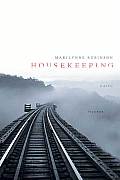
Book Review: Housekeeping

Housekeeping by Marilynne Robinson

This book kept coming to me, referenced with other books I've been enjoying this year and might prove inspirational for my current project, including Daniel Woodrell's Winter's Bone. Woodrell and Robinson share the same agent, which also pushed the novel in my direction.

I did not immediately like the book. A family history is delivered in a very distracted, detached way. It takes some time before we ever feel the narrator's feelings, but still her descriptions, her narration amount to little else than a description of activities and observations of the actions of others. It isn't really until the second half of the novel and the arrival of Sylvie that the novel begins to take off. And it ascends from there.

The book takes on a style that is nearly fantastical, where the reader cannot always find the barrier between reality and imagination. All scenes come to us nearly like a mystical trance. And these pages make for all the earlier faults.

I'd read the excerpt of her second novel Gilead when it appeared in the New Yorker and I was actually annoyed by it, peeved by the necessary religiosity and epistolary style of it. Now, though, I may have to give it a try.

Friday, October 27, 2006

Richard Ford Reading

Why does one go to an author reading? Is it to brush fame, even if it is only an author, Pulitzer-prize winning or not, who would likely not even be recognized on the street by you or anyone else? Is it because we seek inspiration, as if the audience was full of writers seeking something, anything that might aid their craft or make the artistic process any bit easier? Or is because, as lovers of literature, we seek information and understanding of the creator of works we cherish? Oh, that sounds mightily grand, that last one, and it might be true for some, but I'm pretty sure it's a combination of the three that took me to the Tattered Cover last night to see Richard Ford. He is probably one of the most important living writers and it would foolish of me not to go to his appearance. It is almost as if I owe him my presence, another filled seat, because his writing has been so important to me--never mind those things I said about Independence Day. After all of this there is little wonder that I couldn't muster the excitement to go see Bret Easton Ellis last month.

Ford's reading was inspirational. It was enjoyable to hear him read, particularly because he read a section of his new novel The Lay of The Land that had been excerpted in the New Yorker. Ford is funny. Or should I say, his character Frank Bascombe is funny. To hear Ford read it really brought out the humor, along with the exasperated cynicism. What was more inspirational was his ability to answer audience questions with thorough and honest answers. He said that young authors should not be afraid to fill their novels with everything they can do. The writer's whole wealth of knowledge should be allowed into the book. This is important, but it leads, I think, to a problem that I think Ford has of putting everything into a novel and walking away quite empty. It probably leads to some of the problems that Michiko Kakutani sees with the novel.

And, of course, it was good to brush fame, to shake the man's hand and share a few words.

Monday, October 16, 2006

New Yorker fiction: Joyce Carol Oates’s “Landfill”

Every week, the New Yorker publishes a high-profile piece of short fiction, and I would like to say I read them all. I don’t. Not yet. But I am always curious about the stories that get published. So what follows here is my first attempt to look critically at one of the stories published in the last few weeks.

New Yorker fiction: Joyce Carol Oates’s “Landfill”

I could put aside the ripped-from-the-headlines aspect of this story except that it is told (at least the first half or so) in a reportage style. We have facts, laid upon fact, laid upon speculation. We are given no scenes and no real dialogue until late in the story. At the halfway point I was still waiting for the story to start.

Oates is a very talented writer and I have no reason to think that she slapped this one together and the New Yorker printed it on her name alone (although we could spend much more time on how the New Yorker does choose its stories). We get some impressions from the dead son, more memorable ones from his college roommates, but the story really belongs to his mother, Mrs. Campos. During the three weeks before they find her son’s body, she is doing her best to hold onto hope, despite the look on her husband’s face and despite the fact that she knows better. The story begins to move here and we understand her struggle, though Oates dues burden the reader with the all the hopes and fears she had for her son.

What makes the story work, really click, and sustain in memory is the image, the desire and hope in the last paragraph:

Unconsciously caressing her left breast, holding her left breast in her right hand—how like a sac of warm water it is, or warm milk—and, on the brink of a dream of surpassing beauty and tenderness, Mrs. Campos shuts her eyes. Why does Mr. Campos never caress her breasts anymore? Why does Mr. Campos never suck her nipples anymore? Mrs. Campos runs her thumb over the large soft nipple, stirring it to hardness, like a little berry. She is driving back from the city, driving back from ugly Detroit to Whispering Woods Estates, such joy, such pride, turning into the brick-gated subdivision off Southfield Road, making her way floating along Pheasant Pass, Larkspur Drive, Bluebell Lane, and, at last, to Quail Circle, where, in the gleaming-white Colonial at No. 23, the Campos family lives.

Her loss makes her aware of her own desire, her need for love. Then Oates follows up, with contrast, by “floating” back into the fact-laden reporting.

I have much too much respect for Oates to be let down by a story, to say that it’s not a very good story, but I didn’t really appreciate it as much as I would have liked. Leave it to that ending though to explain why I am still thinking about it.

Wednesday, October 11, 2006

Joyce Carol Oates's New Yorker story upsets some

This one sits waiting to be read on my reading table.

Criticism for Joyce Carol Oates
A New Jersey college has called Joyce Carol Oates insensitive, saying that her latest short story, published in the Oct. 9 issue of The New Yorker, resembles the true story of John A. Fiocco Jr., a 19-year-old freshman at the College of New Jersey whose body was found in a landfill in April. Her story, "Landfill," is the tale of a Michigan State University student, Hector Campos Jr., who is forced down a trash chute in a fraternity house and later found dead in a landfill.

"Insensitive?" Using real-world stories for fiction is far from unusual, and I suppose I understand how it might upset some to read a story about a death that resembles a real-life incident, but it is fiction and what requirement is there for a writer to be "sensitive?"