The fun/sadness is in the story itself: Bookcase 'trap' killed US woman
The body of a missing US woman has been found by her family, wedged upside down behind a bookcase in her room.
Mariesa Weber, 38, is believed to have fallen over and become trapped as she tried to reach behind the bookcase to adjust the plug for a TV set.
[...]
Her body was eventually discovered when her sister noticed a foot protruding behind the bookcase in her bedroom.
"I'm sleeping in the same house as her for 11 days, looking for her. And she's right in the bedroom," the woman's mother, Connie Weber, told the St Petersburg Times newspaper.
The family told the newspaper they had noticed a strange smell from her room but had blamed it on rats.
(via Bookninja)

Tuesday, November 28, 2006

NYT Notable Books of 2006
So, the NYT has picked it's notable books of the year and of course there are some good ones on the list:
ABSURDISTAN. By Gary Shteyngart.
AGAINST THE DAY. By Thomas Pynchon.
THE COLLECTED STORIES OF AMY HEMPEL.
THE DEAD FISH MUSEUM. By Charles D'Ambrosio.
THE ECHO MAKER. By Richard Powers.
EVERYMAN. By Philip Roth.
GALLATIN CANYON: Stories. By Thomas McGuane.
HIGH LONESOME: New & Selected Stories, 1966-2006. By Joyce Carol Oates.
THE INHERITANCE OF LOSS. By Kiran Desai.
THE LAY OF THE LAND. By Richard Ford.
ONLY REVOLUTIONS. By Mark Z. Danielewski.
THE ROAD. By Cormac McCarthy.
TERRORIST. By John Updike.
TWILIGHT OF THE SUPERHEROES. By Deborah Eisenberg.
READING LIKE A WRITER: A Guide for People Who Love Books and for Those Who Want to Write Them. By Francine Prose.
Of the list, fiction and non-fiction, I've only read four. That's probably more than I did last year.
ABSURDISTAN. By Gary Shteyngart.
AGAINST THE DAY. By Thomas Pynchon.
THE COLLECTED STORIES OF AMY HEMPEL.
THE DEAD FISH MUSEUM. By Charles D'Ambrosio.
THE ECHO MAKER. By Richard Powers.
EVERYMAN. By Philip Roth.
GALLATIN CANYON: Stories. By Thomas McGuane.
HIGH LONESOME: New & Selected Stories, 1966-2006. By Joyce Carol Oates.
THE INHERITANCE OF LOSS. By Kiran Desai.
THE LAY OF THE LAND. By Richard Ford.
ONLY REVOLUTIONS. By Mark Z. Danielewski.
THE ROAD. By Cormac McCarthy.
TERRORIST. By John Updike.
TWILIGHT OF THE SUPERHEROES. By Deborah Eisenberg.
READING LIKE A WRITER: A Guide for People Who Love Books and for Those Who Want to Write Them. By Francine Prose.
Of the list, fiction and non-fiction, I've only read four. That's probably more than I did last year.
Monday, November 27, 2006
Rejection Collection - AGNI
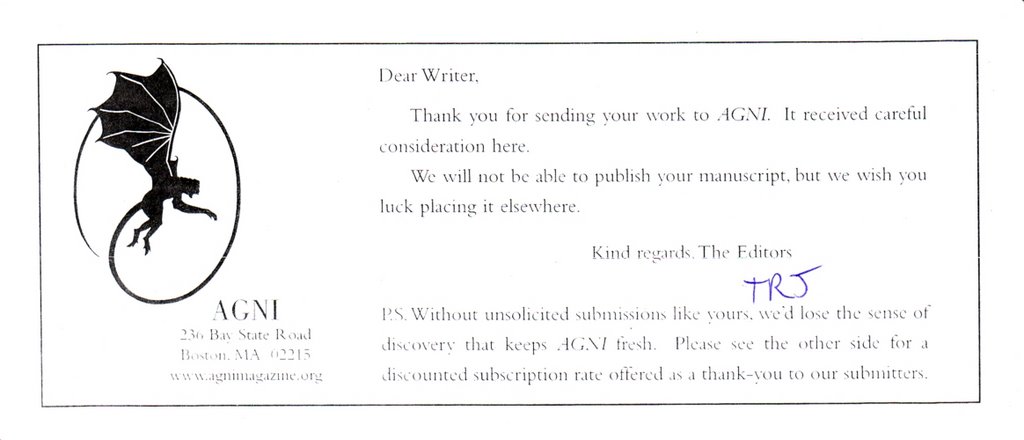
Now, this has to be the quickest turn around I've ever seen out of a lit journal. I sent out my story "Resting" to them on the 14th of this month and on the 24th I received this kind rejection from AGNI. Now, what I appreciate about this one, besides the turnaround, is the enticement to purchase a subscription and discount rate for submitters. Good idea. What doesn't work is that they put the form on the back of the rejection. Don't they realize that I'm putting this in the fat file with all the others?
Friday, November 24, 2006
Vacation Filler: The Black Angels
I just love coming across new music. Today, it's Austin's The Black Keys. Enjoy.
Thursday, November 23, 2006

Tuesday, November 21, 2006
When in doubt, just write.
It is funny that we occasionally need to be reminded of some of the basic tenets of writing.
I found myself over the weekend at a point in “the project” where I knew what was to take place in the present action, but I needed to inform the reader about things from the character’s past that has put him in the current position and made him who he is in the present action. The trouble was that I couldn’t think of one specific event I could use, something that he might remember that would really explain things. I thought I was blocked.
I had the first sentence of the scene written but was afraid to put anything else down until I knew where I was going, So, I put myself through a free-writing exercise, putting down on paper some of the things I had been keeping in my head about him. What I wound up with was only more generalities, no specifics. I had the concepts for what changed him, but still nothing concrete I could use.
I decided to go on with the present action. If I needed to come in and put in another scene later, I would. What I found, though, (and here’s where we get back to basics) was that the thing wrote itself. I didn’t need to say “okay, I need to throw in this specific scene where his father ignores him,” or some such thing. Instead, many little mini-scenes appeared, little bits of action or images along with the character’s opinions of the past. This told more about what he’d been through and where he was than any contrived scene would have.
And so I’m reminded of a couple things that even the silliest of writing books tell us. First, contrivance is what it is and will appear as much on the page, and it is right to be reluctant to do it. And of course, just write. Keep at it. Have faith that you’ll sort out what needs it, either through the course of writing or during the writing. A familiar pearl of wisdom, I understand, but sometimes we need to be reminded.
I found myself over the weekend at a point in “the project” where I knew what was to take place in the present action, but I needed to inform the reader about things from the character’s past that has put him in the current position and made him who he is in the present action. The trouble was that I couldn’t think of one specific event I could use, something that he might remember that would really explain things. I thought I was blocked.
I had the first sentence of the scene written but was afraid to put anything else down until I knew where I was going, So, I put myself through a free-writing exercise, putting down on paper some of the things I had been keeping in my head about him. What I wound up with was only more generalities, no specifics. I had the concepts for what changed him, but still nothing concrete I could use.
I decided to go on with the present action. If I needed to come in and put in another scene later, I would. What I found, though, (and here’s where we get back to basics) was that the thing wrote itself. I didn’t need to say “okay, I need to throw in this specific scene where his father ignores him,” or some such thing. Instead, many little mini-scenes appeared, little bits of action or images along with the character’s opinions of the past. This told more about what he’d been through and where he was than any contrived scene would have.
And so I’m reminded of a couple things that even the silliest of writing books tell us. First, contrivance is what it is and will appear as much on the page, and it is right to be reluctant to do it. And of course, just write. Keep at it. Have faith that you’ll sort out what needs it, either through the course of writing or during the writing. A familiar pearl of wisdom, I understand, but sometimes we need to be reminded.
Friday, November 17, 2006
This week in politics for November 17
Everything seems pretty mundane after last week
- You know there’s not a lot happening when this is your headline: Ark. governor defends gift registries
- Recent Republican scandals make being a racist seem benign, so Lott bids for return to Senate leadership. And of course, Trent Lott Wins Back Senate Leadership Slot
- Dems elect the first female speaker of the house ever: House Democrats name Pelosi speaker
- Everyone is trying to make something out of the leadership fight between John Murtha and Steny Hoyer, but I don’t know why: Democrats Elect Hoyer As New Majority Leader
- Carville slams Dean (never mind that he orchestrated a huge win) and again I don’t know why: Democrats Revert to Finger-Pointing
- Seeing the writing on the wall for the new congress, White House resubmits 6 court nominees
- As further proof that Republicans learned nothing from the election, Boehner, Blunt Win House GOP Leader Jobs
- Nice: “The Bush administration has appointed a new chief of family-planning programs at the Department of Health and Human Services who worked at a Christian pregnancy-counseling organization that regards the distribution of contraceptives as "demeaning to women."” Bush Choice for Family-Planning Post Criticized
Almost like we could breathe easy for a moment.
Rejection Update
A little late, but I sent out more submissions this week in order to catch those lit journals with a limited reading period. So, the numbers: of the batch of 25 sent in August, 7 remain in circulation. The new batch, including a new, hopefully faster-paced story to Northwest Review, goes out to 18 different journals. As of today, there are 25 submissions floating around out there.
Cross your fingers.
Cross your fingers.
Wednesday, November 15, 2006
On NaNoWriMo
It is easy to get protective over something we do, that we feel is special, requires a certain amount of talent, skill, and a shit-load of hard work. So, it may feel natural to react negatively to a bunch of amateurs giving it a go and patting themselves on the back the whole way. Such is the world of National Novel Writing Month, and the accompanying attitude of those with a bit more concern about the quality of work than about total word count. Yes, I admit that I can't help but resent someone who's never even written a short story banging out over 1500 words a day. I wish I could do that. But my resentment ends there.
I have to think that NaNoWriMo weeds out a lot of would-be writers. It's one month of make-it-or-break-it writing. Like a jaded writing teacher, I want them to learn that it's damn hard work and if they're not cut out for it, better they learn now. But the whole idea is about encouragement, a healthy challenge among writers. That sounds to me like a good thing.
For more on the NaNoWriMo discussion: The Millions, Shaken & Stirred, Counterbalance, Mark Leahy at MetaxuCafe.
I have to think that NaNoWriMo weeds out a lot of would-be writers. It's one month of make-it-or-break-it writing. Like a jaded writing teacher, I want them to learn that it's damn hard work and if they're not cut out for it, better they learn now. But the whole idea is about encouragement, a healthy challenge among writers. That sounds to me like a good thing.
For more on the NaNoWriMo discussion: The Millions, Shaken & Stirred, Counterbalance, Mark Leahy at MetaxuCafe.
'The Echo Maker' Wins National Book Award.
National Book Award: 'The Echo Maker'
Damnit! Behind the curve again.
Another one to add to my reading list.
Note: Ed Champion rounds-up the Richard Powers web/press chatter.
Damnit! Behind the curve again.
Another one to add to my reading list.
Note: Ed Champion rounds-up the Richard Powers web/press chatter.
Monday, November 13, 2006
Book Review: Housekeeping
 Housekeeping by Marilynne Robinson
This book kept coming to me, referenced with other books I've been enjoying this year and might prove inspirational for my current project, including Daniel Woodrell's Winter's Bone. Woodrell and Robinson share the same agent, which also pushed the novel in my direction.
I did not immediately like the book. A family history is delivered in a very distracted, detached way. It takes some time before we ever feel the narrator's feelings, but still her descriptions, her narration amount to little else than a description of activities and observations of the actions of others. It isn't really until the second half of the novel and the arrival of Sylvie that the novel begins to take off. And it ascends from there.
The book takes on a style that is nearly fantastical, where the reader cannot always find the barrier between reality and imagination. All scenes come to us nearly like a mystical trance. And these pages make for all the earlier faults.
I'd read the excerpt of her second novel Gilead when it appeared in the New Yorker and I was actually annoyed by it, peeved by the necessary religiosity and epistolary style of it. Now, though, I may have to give it a try.
Rejection Collection - Northwest Review
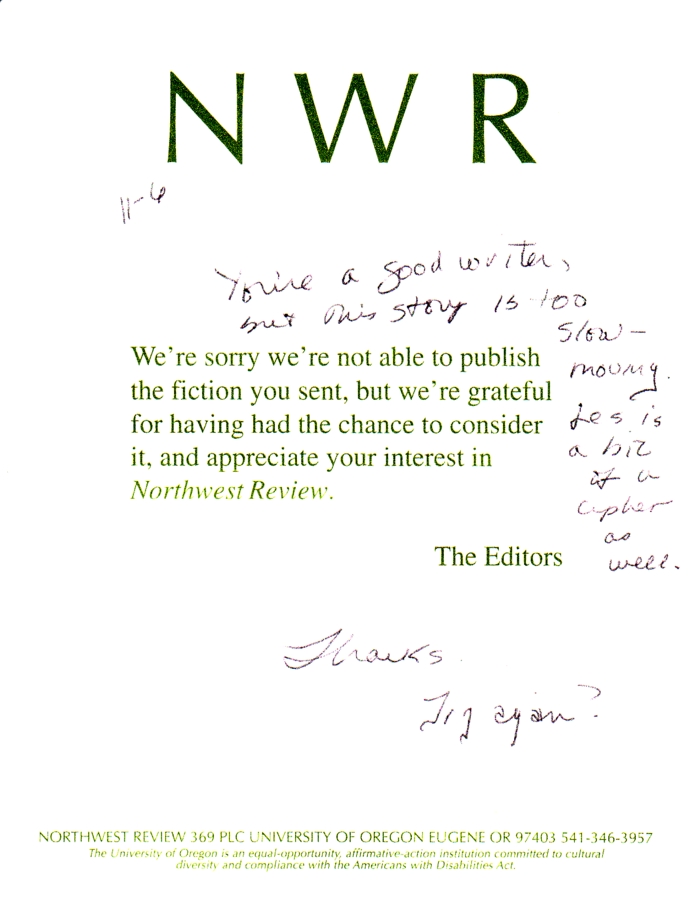 Now, here's the kind I like to see. This one came in the mail today from Northwest Review for my story "Resting." The personal note says,"You're a good writer, but this story is too slow-moving. Les is a bit of a cipher as well. Thanks. Try again?" Now, I could be sensitive about the criticism here, but I have no doubt that it really was too slow-moving for them. Also, Les really is a bit of a cipher. The thing is that this is a rejection. The bad news is what it's all about. So, what I'm reading it for is the good news: acknowledgement of my ability and a bit of encouragement. If only all the rejections were this encouraging. I'll send them another story tomorrow.
Friday, November 10, 2006
This week in politics for November 10
Quite a week. The victories keep coming.
- On Monday, military publications’ editorials pronounce “Rumsfeld Must Go” (Military Times).
- After polling trouble across the country, the reports came in Tuesday night: Democrats Take Control of U.S. House for First Time in 12 Years
- Then after a thumping on Tuesday, Bush announces on Wednesday (never mind that he swore/lied last week that he would keep him,: Rumsfeld resigns as secretary of defense
- So, reaching back to one of his Daddy’s guys, Bush tabs Gates for defense secretary
- On Thursday, finally, after throwing the football around a little bit, Virginia Sen. Allen concedes defeat
- So, that means Democrats control both houses after Virginia win
- Proving accountability for errors exists, Mehlman to step down from RNC post
- No kidding? Elections may shift U.S. Iraq war policy
- Remember Bush’s recess appointment of the UN ambassador? Dems say that ain’t gonna work: Bolton unlikely to win Senate approval
- Couldn’t wait a week, could he? Iowa Gov. Vilsack running for president
- Elsewhere, Saddam is guilty and sentenced to hang, meanwhile the reaction is what you’d expect: In a Divided Iraq, Reaction to Saddam Death Sentence Conforms to Sectarian Lines
- A government website meant to bolster the excuses for invading Iraq by showcasing documents that proved they were prepared to build a nuclear weapon (never mind that these were from before the first Gulf War) actually gave the plans on how to build a bomb: U.S. shutters site with Saddam-era files
I think I need another week, just to recover.
Richard Ford Interviews and Reviews for 'Lay of the Land'
Denver Post - Back with Frank Bascombe at the Jersey Shore
Denver Post (interview) - Richard Ford on writing
NPR - Richard Ford's 'The Lay of the Land'
NPR (again) - Getting Ford's 'Lay of the Land'
Pittsburgh Post-Gazette - 'The Lay of the Land' by Richard Ford
The Independent - The Lay of the Land, by Richard Ford BLOOMSBURY £17.99
Bloomberg - Richard Ford's Frank Bascombe Plunges Amiably Into Middle Age
Mediabistro.com - Richard Ford: still a Jersey Boy after all these years
Oregonlive.com - Facts about Richard Ford:
Wall Street Journal - Richard Ford on Fictional Realism
Slate - Richard Ford's third Bascombe novel.
Baltimore Sun - The details of daily life - maybe to excess
Washington Post - Third Quarter
Newsday - Living the SUV life on the Jersey shore
The Age - The fiction writer
NY Times - A New Jersey State of Mind
NY Observer - And Now It’s a Trilogy
Globe and Mail - Everyman in autumn
Seattle Post Intelligencer - Ford is frank about ending Bascombe series
USA Today - Ford's 'Land' is difficult to survey
NY Times (Kakutani) - Lay of the Land
NY Daily News - The author of 'The Sportswriter' returns to familiar interior ...
NY Times (Scott) - Intimations of Mortality
Toronto Star - Ford lets Frank drift
Like I’m really going to read all of these. I really only suggest the first two because their local and written by David Milofsky.
I will, though, be tackling this book next…I think.
Denver Post (interview) - Richard Ford on writing
NPR - Richard Ford's 'The Lay of the Land'
NPR (again) - Getting Ford's 'Lay of the Land'
Pittsburgh Post-Gazette - 'The Lay of the Land' by Richard Ford
The Independent - The Lay of the Land, by Richard Ford BLOOMSBURY £17.99
Bloomberg - Richard Ford's Frank Bascombe Plunges Amiably Into Middle Age
Mediabistro.com - Richard Ford: still a Jersey Boy after all these years
Oregonlive.com - Facts about Richard Ford:
Wall Street Journal - Richard Ford on Fictional Realism
Slate - Richard Ford's third Bascombe novel.
Baltimore Sun - The details of daily life - maybe to excess
Washington Post - Third Quarter
Newsday - Living the SUV life on the Jersey shore
The Age - The fiction writer
NY Times - A New Jersey State of Mind
NY Observer - And Now It’s a Trilogy
Globe and Mail - Everyman in autumn
Seattle Post Intelligencer - Ford is frank about ending Bascombe series
USA Today - Ford's 'Land' is difficult to survey
NY Times (Kakutani) - Lay of the Land
NY Daily News - The author of 'The Sportswriter' returns to familiar interior ...
NY Times (Scott) - Intimations of Mortality
Toronto Star - Ford lets Frank drift
Like I’m really going to read all of these. I really only suggest the first two because their local and written by David Milofsky.
I will, though, be tackling this book next…I think.
Thursday, November 09, 2006
A Thumpin'
Ah, victories abound.
Of course, I came into work yesterday and got a thumpin' as well, so no posts, no time for the good analysis this whole thing deserves. I'll get there.
In the meantime, celebration is necessary.
Of course, I came into work yesterday and got a thumpin' as well, so no posts, no time for the good analysis this whole thing deserves. I'll get there.
In the meantime, celebration is necessary.
Tuesday, November 07, 2006

Monday, November 06, 2006
Publishers Weekly best of 2006
Not even December yet, but Publishers Weekly thinks they know the best books of the year already (via Bookslut).
The only fiction on the list that I've read: The Road.
The only fiction on the list that I've read: The Road.
Book Review: Reading Like a Writer
 Reading Like a Writer by Francine Prose
Writing books are usually about as useful as a writing workshop. Some information is helpful and other can be dismissed. Francine Prose, in Reading Like a Writer, spends less time on advising writers how to write than she does on telling them how to read.
I could certainly provide many clearly articulated words of wisdom from Prose here, but what you'd miss is how she takes extended excerpts of other texts and explicates them, looking at everything including the smallest word choice or gesture.
I've never read Prose's fiction, but if she puts as much care/work into writing as she does reading, then I'm sure it's worthy of all the praise it receives. I will tell you that I'm now planning to go back and read again everything by Chekhov.
Used vs. New
There's nothing in the world like a library book sale. I had the pleasure and luxury of going to one twice last weekend. Once when hardbacks were $2 and paperbacks were $1, then again on the last day when a bag stuffed full of books was only $4. I know, I know, I should be supporting publishers and authors by purchasing new books, but it also makes me a little sad to see a really good book out on the table along with twenty dusty copies of really bad popular books. I came home with over forty books and part of me wonders why I would ever go to a book store again.
As much as I love used books, I have never bought as many new, hardcover books as I have this year (D'ambrosio, Woodrell, McCarthy, Ford, and more). And not just as gifts. I'm more than pleased to help out their numbers and shell out the money for books I'm dying to read. When books get a little older, I wonder why I should being paying full price for a book that's been sitting there on the shelf for a couple of years or more when I can go to a book sale or used bookseller and pick up the same book at a considerable discount.
I have always loved used book stores. Dark aisles, shelves crammed with books. I'm always looking for the rarity, the special first edition or out of print book I can't find elsewhere. And then there are classics, public domain books or not, in mass-market size that I really should own and read. How can I rationalize paying full-price for these?
I don't really think I can take a side on this. I'm cheap and I love a good bargain, but I want to support authors and the industry. So, if I want To the Lighthouse, I'll look for it used, and if I want the next Litblog Co-op pick (I'm particularly interested in Sidney Thompson's collection Sideshow), I'll buy new.
As much as I love used books, I have never bought as many new, hardcover books as I have this year (D'ambrosio, Woodrell, McCarthy, Ford, and more). And not just as gifts. I'm more than pleased to help out their numbers and shell out the money for books I'm dying to read. When books get a little older, I wonder why I should being paying full price for a book that's been sitting there on the shelf for a couple of years or more when I can go to a book sale or used bookseller and pick up the same book at a considerable discount.
I have always loved used book stores. Dark aisles, shelves crammed with books. I'm always looking for the rarity, the special first edition or out of print book I can't find elsewhere. And then there are classics, public domain books or not, in mass-market size that I really should own and read. How can I rationalize paying full-price for these?
I don't really think I can take a side on this. I'm cheap and I love a good bargain, but I want to support authors and the industry. So, if I want To the Lighthouse, I'll look for it used, and if I want the next Litblog Co-op pick (I'm particularly interested in Sidney Thompson's collection Sideshow), I'll buy new.
Subscribe to:
Posts (Atom)